Unlike water, slurry or general industrial liquids, dry cement behaves differently.
It is abrasive.
It generates static electricity.
It moves at high velocity.
It rapidly wears components that aren’t specifically designed for dry bulk transfer.
Every tonne of cement travelling through a discharge hose gradually removes material from the inside lining. Over thousands of tonnes, this invisible wear eventually becomes one of the leading causes of hose failure.
For operators working in:
- Cement terminals
- Bulk storage facilities
- Concrete batching plants
- Rail unloading depots
- Shipping terminals
- Lime handling plants
- Quarry operations
- Dry powder processing facilities
selecting the correct hose isn’t simply about moving product.
It’s about protecting personnel, reducing maintenance costs and keeping production moving.
At Fox Global, we supply complete IVG Don Dry Cement Hose Assemblies engineered for Australian bulk material handling operations. Every assembly is professionally manufactured to suit the customer’s application, complete with premium couplings, pressure-tested assemblies and fast Australia-wide delivery.
Whether unloading bulk cement from road tankers, rail wagons or ship-to-shore facilities, our team works closely with engineers, maintenance managers and procurement specialists to deliver complete hose solutions—not just hose lengths.
Australian Industry Depends on Reliable Bulk Material Transfer
Across Australia, millions of tonnes of dry powdered products move every year through pneumatic conveying systems.
These materials include:
- Portland Cement
- Fly Ash
- Lime
- Silica
- Mineral Powders
- Sand
- Dry Aggregate
- Quarry Products
- Fine Abrasive Materials
Many facilities operate 24 hours a day.
Every unexpected hose failure can result in:
- Production downtime
- Lost unloading capacity
- Expensive clean-up
- Dust emissions
- Equipment damage
- Environmental incidents
- Increased maintenance costs
The discharge hose often becomes the hardest-working component in the entire unloading system.
Understanding Dry Bulk Material Transfer
Unlike liquid transfer, dry bulk materials behave more like a rapidly moving abrasive.
As compressed air conveys cement through the hose:
- Particles accelerate.
- Material changes direction.
- Internal friction increases.
- Static electricity develops.
- Abrasion occurs continuously.
Every elbow, coupling and hose lining experiences ongoing wear.
Selecting a hose specifically engineered for abrasive materials dramatically improves service life and reliability.
Introducing the IVG Don Hose
The IVG Don is a premium softwall bulk material handling hose specifically designed for transferring dry abrasive products including:
- Cement
- Lime
- Sand
- Gravel
- Silica
- Other dry abrasive materials
Its construction combines an antistatic, abrasion-resistant NR/SBR rubber tube with high-strength synthetic cord reinforcement and an abrasion-resistant NR/SBR rubber cover, making it suitable for demanding bulk handling environments. It operates across a temperature range of -40°C to +70°C, with recommended coupling options including Camlocks and flanges.
Rather than being designed for high hydraulic pressure, the IVG Don is engineered to withstand the constant abrasion associated with pneumatic dry bulk conveying.
Why Abrasion Resistance Matters
When cement moves through a hose at high velocity, it acts like liquid sandpaper.
The hose lining experiences:
- Continuous particle impact
- High-speed friction
- Material erosion
- Heat generation
- Long-term wear
Eventually, the internal rubber begins to thin.
Once the lining becomes excessively worn:
- Performance declines
- Hose life shortens
- Failure risk increases
Abrasion-resistant rubber compounds significantly extend operational life when compared with general-purpose industrial hose.
Static Electricity – The Hidden Hazard
Many operators focus solely on abrasion.
However, static electricity presents another important consideration.
Fine powdered materials travelling rapidly through rubber hose naturally generate static charges.
Without suitable antistatic hose construction:
- Static build-up may increase
- Dust environments become more hazardous
- Equipment reliability can suffer
The IVG Don incorporates an antistatic hose design, helping make it suitable for dry abrasive material handling applications where static management is important.
Recent Project – South Coast Shipping Terminal
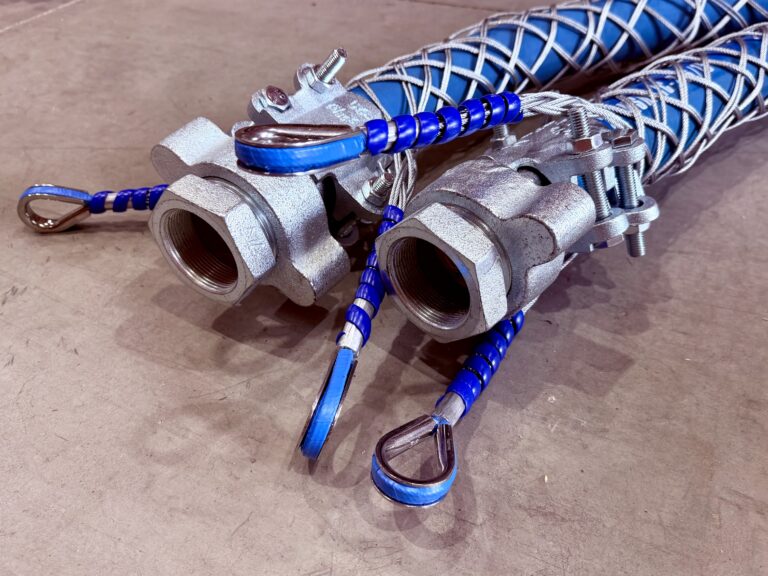
Fox Global recently completed another batch of IVG Don 4″ (100 mm) hose assemblies fitted with mil-spec Wham Camlocks, manufactured for cement unloading operations at a South Coast shipping terminal.
These assemblies were built specifically for unloading abrasive dry bulk cement from terminal infrastructure, providing a reliable connection between unloading equipment and storage facilities.
Every assembly was manufactured with careful attention to:
- Correct hose selection
- Premium coupling installation
- Assembly integrity
- Reliable sealing
- Long service life
Projects like this demonstrate Fox Global’s capability to deliver complete hose assemblies for demanding bulk handling operations across Australia.
Why Engineers Specify Complete Hose Assemblies
Experienced engineers rarely purchase “hose only.”
Instead, they specify complete assemblies because compatibility between the hose and couplings is critical to long-term reliability.
Fox Global can manufacture complete cement hose assemblies incorporating:
- Premium Camlocks
- Mil-spec Wham Camlocks
- Flanged connections
- Custom hose lengths
- Pressure testing
- Identification tags
- Inspection services
- Custom configurations
By supplying complete assemblies, installation is simplified while reducing compatibility issues on site.
Engineered Specifically for Abrasive Dry Bulk Materials
The IVG Don is not a general-purpose industrial hose. It has been engineered specifically for the transfer of abrasive dry bulk products where long service life, flexibility and reliability are essential.
Unlike hoses designed for water or slurry, the IVG Don must continually withstand:
- High-velocity cement particles
- Constant abrasion
- Pneumatic conveying systems
- Repetitive flexing during unloading
- Outdoor weather exposure
- Static electricity generated by moving powders
Every layer of the hose has been selected to maximise performance in these demanding applications.
Hose Construction Explained
Understanding how a hose is constructed helps explain why premium bulk handling hoses significantly outperform general industrial alternatives.
Inner Tube – Abrasion Resistant NR/SBR Rubber
The hose features a black, smooth NR/SBR rubber tube formulated to provide excellent resistance when handling abrasive dry materials such as cement, silica, sand and lime. The smooth bore assists with efficient material flow while reducing unnecessary turbulence.
Benefits
- Excellent abrasion resistance
- Suitable for dry powders
- Smooth internal flow
- Long operational life
- Reduced internal wear
Reinforcement – High Strength Synthetic Cord
Unlike hydraulic hoses that rely on steel wire reinforcement, the IVG Don uses high-strength synthetic cord reinforcement designed to provide flexibility while maintaining structural integrity during pneumatic unloading operations.
Advantages include:
- Flexible handling
- Reduced operator fatigue
- Excellent dimensional stability
- Suitable for repetitive unloading cycles
The reinforcement allows the hose to remain manageable while supporting the working pressures associated with dry bulk transfer.
Outer Cover – Abrasion Resistant Rubber
The outer cover is manufactured from black NR/SBR rubber with a wrapped finish, providing excellent resistance to abrasion and external wear.
During unloading operations, hoses are regularly dragged across:
- Concrete hardstands
- Wharf decks
- Steel loading platforms
- Rail infrastructure
- Trailer frames
- Quarry surfaces
A durable outer cover helps maximise hose life under these demanding conditions.
Operating Temperature
The IVG Don is designed to operate across a wide temperature range, making it suitable for Australian conditions.
| Property | Specification |
|---|---|
| Minimum Temperature | -40°C |
| Maximum Temperature | +70°C |
This allows the hose to perform in environments ranging from cold southern winters through to hot inland and coastal industrial sites.
Working Pressure
Although cement unloading systems are generally pneumatic rather than hydraulic, selecting the correct working pressure remains essential.
Depending on the hose configuration, the IVG Don range is available with working pressures of:
- 5 bar (75 PSI)
- 6 bar (90 PSI)
with corresponding burst pressures of:
- 15 bar (225 PSI)
- 18 bar (270 PSI).
Correct pressure selection should always consider:
- Blower output
- Conveying distance
- Product density
- Equipment specifications
- Site operating procedures
Available Sizes
The IVG Don range is available in several popular diameters to suit bulk material handling systems.
| Nominal Size | Typical Application |
|---|---|
| 3″ (76 mm) | Smaller unloading systems |
| 3½” (90 mm) | Bulk transfer |
| 4″ (102 mm) | Cement unloading |
| 5″ (127 mm) | High-volume transfer |
Maximum continuous lengths of up to 120 metres are available depending on the size and configuration.
Why 4-Inch Hose Is the Industry Favourite
The 4″ (100 mm) size has become one of the most widely used configurations across Australian cement terminals and bulk powder facilities.
Reasons include:
- Excellent material flow
- Compatible with common tanker systems
- Efficient unloading rates
- Readily available fittings
- Proven industry performance
Fox Global regularly manufactures 4″ IVG Don hose assemblies for cement unloading, rail terminals, shipping facilities and industrial processing plants.
Camlocks or Flanges?
Selecting the correct connection is just as important as selecting the hose itself.
The IVG Don is commonly assembled with:
- Camlock couplings
- Flanged ends
depending on the customer’s equipment and operating requirements.
Camlock Assemblies
Camlocks remain one of the most popular connection systems for mobile unloading equipment.
Advantages
✔ Fast connection
✔ Simple operation
✔ Minimal tools required
✔ Easy maintenance
✔ Excellent interchangeability
Fox Global can supply premium mil-spec Wham Camlocks where a robust, heavy-duty connection is required for demanding industrial applications.
Flanged Assemblies
Flanged hose assemblies are typically preferred where the hose remains permanently installed or forms part of a fixed conveying system.
Advantages include:
- Positive mechanical connection
- Excellent sealing
- Suitable for continuous operation
- Reduced likelihood of accidental disconnection
Typical Australian Applications
Although widely recognised as a cement hose, the IVG Don is used across a broad range of industries handling abrasive dry materials.
Cement Terminals
Bulk road tankers and rail wagons discharge cement into storage silos using flexible hose assemblies capable of withstanding constant abrasion.
Shipping Terminals
Ship-to-shore unloading operations require durable hose assemblies capable of handling continuous product flow while tolerating movement between fixed infrastructure and mobile equipment.
Concrete Batching Plants
Reliable transfer of powdered cement directly influences production efficiency.
Abrasion-resistant hoses help minimise downtime and reduce replacement frequency.
Lime Handling
Hydrated and quicklime are highly abrasive materials requiring purpose-built transfer hoses rather than general industrial rubber hose.
Quarry Operations
Fine mineral products, crushed aggregates and dry powders place significant wear on transfer equipment, making abrasion resistance essential.
Industrial Manufacturing
Manufacturers handling powdered raw materials rely on durable hose assemblies for pneumatic transfer between storage systems and production equipment.
Why Bulk Powder Transfer Is Different
Dry powders behave differently from liquids.
As compressed air moves cement through the hose:
- Particles continually strike the hose wall.
- Static electricity develops.
- Wear occurs gradually.
- Flow characteristics change with product density.
- Moisture contamination can cause blockages.
Selecting the correct hose construction is therefore critical to maintaining consistent unloading performance and extending equipment life.
Why Cement Hose Assemblies Fail – And How to Prevent It
Most cement hose failures don’t occur because the hose has reached the end of its service life.
They occur because the hose has been:
- Incorrectly selected
- Improperly installed
- Poorly maintained
- Used outside its design parameters
- Damaged without anyone noticing
The good news is that many failures are entirely preventable.
Understanding what causes premature hose failure allows maintenance teams to improve reliability, reduce operating costs and minimise unplanned downtime.
The Five Most Common Causes of Failure
1. Internal Abrasion
The biggest enemy of any cement hose is the product it is carrying.
Dry cement, silica and lime are highly abrasive. Every particle travelling through the hose gradually removes a microscopic amount of rubber from the internal lining.
Unlike external damage, this wear cannot usually be seen.
By the time the outside of the hose looks worn, the internal tube may already be approaching the end of its service life.
This is why scheduled inspection and replacement programs are so important for high-use unloading hoses.
2. Incorrect Hose Selection
Not every rubber hose is designed to handle abrasive powders.
General-purpose industrial hoses may initially appear suitable, but often lack:
- Abrasion-resistant tube compounds
- Antistatic properties
- Suitable reinforcement
- Appropriate flexibility
Using the correct hose for the application significantly improves service life and operational reliability.
3. Excessive Hose Movement
During unloading, operators often allow hoses to:
- Drag across concrete
- Rub against trailer frames
- Contact steel pipework
- Bend sharply near couplings
- Twist repeatedly
Over time this causes unnecessary wear.
Correct support and routing can dramatically increase hose life.
4. Damaged Couplings
Even the best hose cannot compensate for damaged or poorly fitted couplings.
Common issues include:
- Impact damage
- Excessive wear
- Incorrect locking
- Damaged cam arms
- Thread wear
- Seal deterioration
Fox Global professionally assembles complete hose assemblies to ensure the hose and coupling work together as one engineered solution.
5. Moisture Contamination
Dry bulk conveying systems rely on free-flowing product.
Moisture entering the hose can lead to:
- Product build-up
- Reduced flow
- Increased abrasion
- Blockages
- Difficult cleaning
Correct storage and handling help minimise these risks.
Inspection Checklist
Routine inspections are one of the simplest ways to prevent unexpected failures.
Daily Operator Inspection
Before each unloading operation, inspect for:
✔ Cuts
✔ Cover damage
✔ Excessive abrasion
✔ Loose couplings
✔ Damaged Camlocks
✔ Missing safety clips
✔ Kinks
✔ Flat spots
✔ Product leakage
✔ Signs of crushing
If any significant damage is found, remove the hose from service until it has been inspected.
Weekly Maintenance Inspection
Maintenance personnel should also examine:
- Internal tube condition where possible
- Coupling security
- Hose flexibility
- Reinforcement exposure
- Signs of excessive wear near the ends
- Camlock locking arms
- Gaskets
- Hose identification
Maintaining inspection records assists with planned replacement programs and reduces unexpected failures.
Correct Installation Practices
Even premium hose assemblies can have a reduced service life if installed incorrectly.
Best Practice
✔ Use the correct hose length.
✔ Avoid twisting during installation.
✔ Support long hose runs where practical.
✔ Protect hoses from unnecessary abrasion.
✔ Keep hoses clear of sharp edges.
✔ Inspect couplings before connection.
✔ Ensure Camlocks are fully engaged.
Avoid
✘ Pulling the hose by the coupling.
✘ Using the hose as a lifting point.
✘ Exceeding the working pressure.
✘ Leaving hoses permanently under tension.
✘ Driving over hose assemblies.
✘ Allowing hoses to rub continuously against steel.
These simple practices can substantially extend service life.
Storage Matters More Than Many People Realise
Hoses spend much of their life in storage rather than in operation.
Poor storage practices often reduce service life before the hose is even used.
Fox Global recommends storing hose assemblies:
- Clean and dry
- Out of direct sunlight where practical
- Away from ozone-producing equipment
- Free from chemical contamination
- Without sharp bends or kinks
- Off the ground where possible
- Protected from impact damage
The IVG safety information also highlights that correct selection, storage, installation, use and maintenance are essential to maximise hose performance and safety.
Buyer’s Guide – Choosing the Right Cement Hose Assembly
Every bulk handling system is different.
Before ordering a replacement hose, consider the following questions.
| Question | Why It Matters |
|---|---|
| What material are you conveying? | Cement, lime, silica and sand all behave differently. |
| What hose diameter is required? | Influences flow rate and compatibility. |
| What working pressure does the system operate at? | Ensures correct hose selection. |
| What end connections are fitted? | Camlocks, flanges or custom connections. |
| Is the hose used indoors or outdoors? | Determines exposure to UV and weather. |
| Is the hose mobile or permanently installed? | Influences coupling selection. |
| Is abrasion a significant issue? | May require additional protection or different routing. |
| Are pressure testing or identification tags required? | Often specified for major industrial projects. |
Why Complete Assemblies Deliver Better Value
Purchasing a complete hose assembly rather than sourcing individual components separately offers several advantages.
Fox Global supplies complete assemblies that are:
- Professionally manufactured
- Correctly coupled
- Ready for immediate installation
- Pressure tested where required
- Configured to customer specifications
This simplifies procurement while reducing compatibility issues and installation time.
Practical Example – Brisbane Rail Cement Unloading
Fox Global recently supplied a batch of 4″ (100 mm) IVG Don rubber hose assemblies for a dry cement rail loading yard in Brisbane.
Each assembly was manufactured to suit abrasive dry bulk transfer, providing a durable solution for unloading cement from rail infrastructure into storage facilities.
By using purpose-built IVG Don hose assemblies rather than general-purpose industrial hose, operators benefit from:
- Improved abrasion resistance
- Reliable product flow
- Reduced maintenance
- Longer service life
- Greater operational confidence
This is another example of Fox Global supporting Australia’s bulk handling industry with engineered hose solutions tailored to demanding applications.
Camlocks vs Mil-Spec Wham Camlocks – Which Connection Is Right?
The hose is only one part of the transfer system. Selecting the correct coupling is equally important, particularly in bulk cement unloading where reliability, sealing performance and ease of operation directly affect productivity.
Fox Global supplies IVG Don hose assemblies with a range of coupling options, including premium Camlocks and heavy-duty mil-spec Wham Camlocks, depending on the application.
Standard Camlocks
Camlocks are one of the most widely used quick-connect systems in Australian industry.
Advantages
- Fast connection and disconnection
- No specialist tools required
- Excellent interchangeability
- Widely available replacement parts
- Suitable for many industrial applications
Typical industries include:
- Concrete batching
- Manufacturing
- Agriculture
- Water treatment
- General industrial processing
Mil-Spec Wham Camlocks
For demanding environments such as ports, mining operations and bulk terminals, many operators choose Wham Camlocks because of their robust construction and suitability for heavy-duty service.
Typical applications include:
- Ship unloading
- Bulk cement terminals
- Rail unloading
- Mining
- Quarry operations
- High-cycle industrial applications
Fox Global regularly manufactures IVG Don hose assemblies fitted with premium Wham Camlocks for customers requiring a durable connection capable of withstanding harsh Australian operating conditions.
Where Are Cement Hose Assemblies Used?
Although commonly referred to as “cement hoses”, these assemblies are utilised across a wide range of bulk powder industries.
Bulk Cement Storage Facilities
Large storage terminals receive cement via:
- Bulk road tankers
- Rail wagons
- Coastal shipping
- Import terminals
Reliable hose assemblies ensure efficient transfer from transport vehicles into storage silos.
Shipping Terminals
Marine unloading operations often involve continuous product movement over extended periods.
Hoses must remain flexible while resisting:
- Abrasion
- Weather
- Repeated handling
- Mechanical wear
- Outdoor exposure
Fox Global supplies hose assemblies suitable for these demanding environments.
Rail Unloading Facilities
Rail continues to play an important role in Australia’s bulk cement supply chain.
Specialised hose assemblies connect unloading systems to storage infrastructure while accommodating movement between fixed and mobile equipment.
Concrete Manufacturing
Concrete batching plants rely on consistent cement supply to maintain production schedules.
Reliable hose assemblies help minimise:
- Downtime
- Product loss
- Dust emissions
- Maintenance interruptions
Lime Processing Plants
Hydrated lime is highly abrasive and requires hose assemblies specifically designed for dry powder transfer rather than general-purpose rubber hose.
Quarry and Mineral Processing
Many quarry operations convey:
- Limestone
- Silica
- Mineral fillers
- Fine aggregate
- Powdered products
The abrasion-resistant construction of the IVG Don makes it well suited to these applications.
Troubleshooting Guide
The table below outlines common issues encountered during dry bulk material transfer and practical solutions.
| Problem | Possible Cause | Recommended Action |
|---|---|---|
| Reduced unloading rate | Product build-up or hose wear | Inspect internal tube and clean system |
| Product leakage | Damaged gasket or coupling | Replace seals and inspect couplings |
| Excessive cover wear | Hose rubbing against steel or concrete | Improve routing or support hose |
| Difficulty connecting Camlocks | Damaged arms or worn gasket | Replace worn components |
| Product blockages | Moisture contamination | Dry system and inspect product handling procedures |
| Premature hose wear | Incorrect hose selection | Review application and specify an abrasion-resistant hose |
Early identification of these issues can reduce unplanned downtime and extend the service life of the hose assembly.
Frequently Asked Questions
Can the IVG Don hose handle products other than cement?
Yes. The IVG Don is designed for conveying a range of dry abrasive materials, including cement, sand, gravel, silica and lime. Always confirm product suitability for your specific application before installation.
What hose sizes are available?
The IVG Don range includes nominal sizes from 3″ (76 mm) through to 5″ (127 mm), with variants available on request.
What fittings can be supplied?
Fox Global can manufacture complete hose assemblies with:
- Camlocks
- Mil-spec Wham Camlocks
- Flanges
- Custom end connections (subject to application)
Are custom lengths available?
Yes. Hose assemblies can be manufactured to suit customer requirements, subject to manufacturer limitations and application suitability.
Can Fox Global pressure test hose assemblies?
Yes. Pressure testing, identification tags and inspection services can be provided where required to meet customer and project specifications.
How often should cement hoses be replaced?
Replacement intervals depend on:
- Product abrasiveness
- Hours of operation
- Transfer velocity
- Maintenance practices
- Inspection results
Rather than replacing hoses based solely on age, Fox Global recommends regular inspection and planned preventative maintenance.
Why Procurement Teams Choose Fox Global
Procurement managers are increasingly seeking suppliers who provide more than just products.
Fox Global offers:
- Technical product selection
- Complete hose assemblies
- Custom manufacturing
- National freight capability
- Fast response times
- Experienced technical support
- Pressure testing services
- One supplier for complete fluid transfer solutions
By partnering with Fox Global, customers gain access to practical advice and engineered solutions designed to improve reliability and reduce whole-of-life operating costs.
More Than a Hose – A Complete Bulk Material Transfer Solution
In bulk cement handling, every component of the transfer system contributes to productivity. Blowers, pipelines, storage silos and unloading equipment all play a role, but the flexible hose assembly is often the only component that experiences continuous movement while handling highly abrasive material.
Selecting the correct hose assembly is therefore about far more than simply replacing a worn hose.
It is about improving:
- Site safety
- Equipment reliability
- Product flow
- Maintenance planning
- Operational efficiency
- Whole-of-life operating costs
The IVG Don has established itself as a proven solution for dry abrasive material transfer because it combines abrasion-resistant rubber construction, antistatic properties and flexible synthetic reinforcement into a hose specifically designed for bulk powder handling applications. Combined with professionally fitted couplings and correct installation, it provides a dependable solution for Australian industry.
Why Industry Partners with Fox Global
Fox Global is more than an industrial hose supplier.
We work closely with engineers, procurement teams, maintenance managers and operators to deliver complete fluid transfer solutions tailored to each application.
As a proudly Australian-owned and family-operated business, we understand that downtime costs money, and selecting the right hose assembly the first time is critical to maintaining production.
Our customers choose Fox Global because we offer:
✔ Complete hose assembly solutions
✔ Technical product selection
✔ Custom-built hose assemblies
✔ Premium Australian and international brands
✔ Fast Australia-wide delivery
✔ National project supply capability
✔ Pressure testing and hose identification
✔ Responsive customer service
✔ Practical engineering advice
Whether your operation is unloading cement at a shipping terminal, transferring lime into storage silos, conveying silica through a processing plant or supplying a concrete batching facility, Fox Global has the experience and technical knowledge to recommend the right solution.
Our experience extends across:
- Mining
- Civil Construction
- Food & Beverage
- Chemical Processing
- Water Treatment
- Manufacturing
- Agriculture
- Oil & Gas
- Marine
- Waste Management
No matter the industry, our focus remains the same—providing reliable fluid and bulk material transfer solutions that improve safety, performance and long-term value.
Speak to the Bulk Material Handling Specialists
If you’re replacing worn cement hoses, designing a new unloading system or looking for technical advice on abrasive material transfer, our experienced team is ready to help.
We can assist with:
- IVG Don hose selection
- Complete hose assemblies
- Camlock and Wham Camlock configurations
- Flanged hose assemblies
- Custom hose lengths
- Pressure testing
- Identification and tagging
- Technical product advice
- Australia-wide supply
Contact Fox Global Today
📞 1300 852 795