Across Australia, thousands of hoses are connected and disconnected every day.
From piling rigs in Brisbane to bulk loading facilities in Perth, marine fuel transfer operations in Sydney, civil construction projects in Melbourne, and mine sites throughout regional Australia, hoses are relied upon to safely transfer air, water, slurry, chemicals, fuel, grout, and countless other media.
Yet one of the most overlooked safety devices in these applications is often one of the most important.
The hose-to-hose wire whip check.
When a pressurised hose becomes disconnected, the stored energy inside the hose can instantly transform it into a dangerous projectile capable of causing severe injuries, equipment damage, production downtime, and even fatalities.
A simple wire whip check can dramatically reduce this risk.
At Fox Global, we stock a comprehensive range of hose-to-hose wire whip checks suitable for industries including mining, piling, marine, construction, manufacturing, waste management, agriculture, chemical processing, and general industrial applications throughout Australia.
Phone: 1300 852 795
Email: sales@foxglobal.com.au
Understanding Hose Whip: Why It Happens
Many people underestimate the amount of stored energy contained within a pressurised hose.
Whether the media is:
- Compressed air
- Water
- Slurry
- Cement
- Chemicals
- Hydraulic fluids
- Bulk transfer products
Pressure creates stored energy.
When a coupling, fitting, clamp, ferrule, or hose assembly fails unexpectedly, that energy is released instantly.
The hose can begin whipping violently in unpredictable directions.
This phenomenon is commonly referred to as:
- Hose whip
- Hose lash
- Line whip
- Pressure hose recoil
The higher the pressure and larger the hose diameter, the greater the risk.
Even relatively low-pressure hoses can generate enough force to cause serious injury.
What Is a Hose-to-Hose Wire Whip Check?
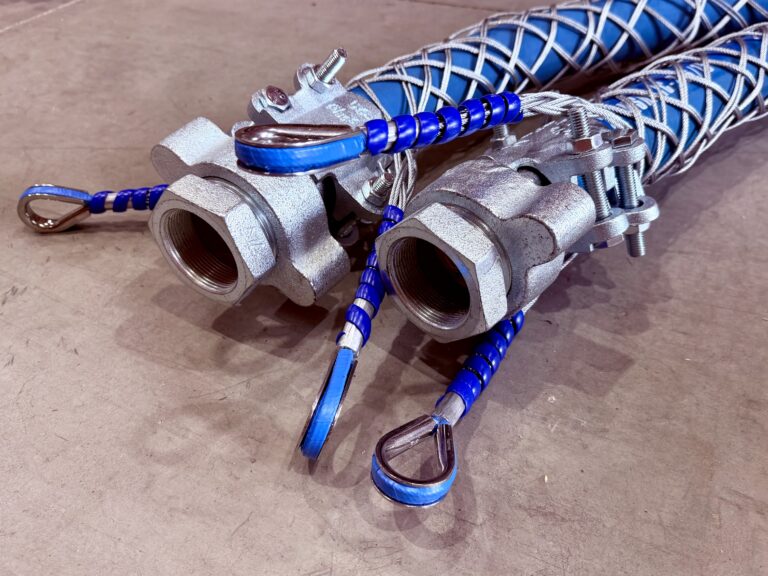
A hose-to-hose wire whip check is a flexible steel cable restraint designed to limit hose movement should a connection fail.
The whip check is installed between two connected hoses and acts as a secondary restraint system.
If the coupling disconnects or fails:
- The whip check absorbs the load.
- Hose movement is restricted.
- The risk of uncontrolled whipping is reduced.
- Personnel protection is increased.
- Equipment damage can be minimised.
The images above show a typical heavy-duty hose-to-hose wire whip check arrangement used on industrial hose assemblies.
Anatomy of a Modern Wire Whip Check
Although designs vary, most industrial whip checks consist of:
Galvanised Steel Cable
Provides high tensile strength and flexibility.
Spring Protection
Protects the cable from fatigue and abrasion at high stress points.
Reinforced Loops
Designed to secure around hose assemblies and couplings.
Corrosion Resistant Construction
Suitable for:
- Marine environments
- Construction sites
- Mining operations
- Outdoor installations
High Load Capacity
Designed to withstand significant shock loading during hose failure events.
Where Are Hose-to-Hose Wire Whip Checks Used?
Piling Industry
Piling contractors operate some of the most demanding hose applications in Australia.
Common applications include:
- Compressed air systems
- Grout transfer
- Bentonite pumping
- Water supply lines
- Pneumatic hammer systems
Hoses are frequently:
- Dragged
- Twisted
- Exposed to vibration
- Subjected to impact damage
A coupling failure during piling operations can create an immediate safety hazard.
For this reason, many contractors specify whip checks as standard equipment.
Civil Construction
Construction sites are constantly changing environments.
Hoses may be exposed to:
- Mobile plant
- Excavators
- Trucks
- Foot traffic
- Temporary installations
Whip checks provide an additional layer of protection where accidental disconnection may occur.
Common construction applications include:
- Dewatering
- Air compressors
- Shotcrete systems
- Grout pumping
- Water transfer
Marine Applications
Marine environments present unique challenges.
Saltwater exposure accelerates corrosion and equipment degradation.
Common marine hose applications include:
- Fuel transfer
- Water transfer
- Washdown systems
- Dredging operations
- Ship-to-shore connections
A hose failure on a vessel or wharf can endanger personnel and damage expensive infrastructure.
Wire whip checks help mitigate these risks.
Mining Operations
Mining operations throughout Queensland, Western Australia, New South Wales and South Australia rely heavily on hose systems.
Applications include:
- Air services
- Water supply
- Dust suppression
- Slurry transfer
- Dewatering systems
Mining operators increasingly specify hose restraint systems as part of site safety requirements.
Manufacturing Facilities
Industrial manufacturing plants utilise:
- Pneumatic systems
- Process water
- Chemical transfer
- Compressed air distribution
Whip checks assist in maintaining safe working environments around production equipment.
The Hidden Costs of Hose Failures
Many businesses only consider the replacement cost of a failed hose.
The real costs are often much higher.
| Potential Consequence | Possible Impact |
|---|---|
| Personnel injury | Medical expenses, investigations |
| Equipment damage | Repairs and replacement |
| Production downtime | Lost revenue |
| Environmental incidents | Clean-up costs |
| Regulatory action | Fines and compliance issues |
| Reputation damage | Client and contractor concerns |
A relatively inexpensive whip check can help reduce exposure to these risks.
Common Causes of Hose Separation
Understanding why hose failures occur helps determine where whip checks should be used.
Incorrect Clamping
Improper clamp selection remains one of the most common causes of hose separation.
Worn Couplings
Couplings subjected to:
- Corrosion
- Impact
- Fatigue
can fail unexpectedly.
Excessive Pressure
Operating beyond the hose working pressure significantly increases risk.
Mechanical Damage
Damage caused by:
- Forklifts
- Vehicles
- Abrasion
- Crushing
can weaken assemblies.
Improper Installation
Incorrect assembly practices may result in reduced retention forces.
Vibration
Long-term vibration can gradually loosen connections.
Hose Whip Checks Versus Hose Restraint Systems
While whip checks are highly effective, they are not the only safety solution available.
| System | Typical Use |
|---|---|
| Wire whip checks | Hose-to-hose connections |
| Whip socks | Larger industrial hoses |
| Hose restraints | High-pressure systems |
| Safety chains | Fixed installations |
| Custom restraint systems | Critical applications |
Fox Global can assist customers in selecting the most suitable restraint method.
Selecting the Correct Whip Check
Several factors should be considered.
Hose Diameter
Larger hoses require heavier restraint systems.
Operating Pressure
Higher pressures generate greater recoil forces.
Media Type
Different products create different risk profiles.
Environment
Consider:
- Corrosion
- UV exposure
- Chemicals
- Abrasion
Connection Type
Whip check sizing must suit the hose assembly and coupling arrangement.
Inspection and Maintenance Best Practices
Like any safety device, whip checks require routine inspection.
Check for:
Cable Fraying
Broken strands indicate replacement is required.
Corrosion
Particularly important in marine environments.
Spring Damage
Bent or damaged springs may reduce protection.
Mechanical Wear
Inspect areas exposed to abrasion.
Deformation
Any significant distortion should be investigated.
Warning Signs That a Whip Check Should Be Replaced
Replace immediately if:
- Cable strands are broken.
- Corrosion is severe.
- Loops are damaged.
- Springs are distorted.
- Excessive wear is present.
- The restraint has been subjected to a major failure event.
Common Mistakes Seen on Australian Job Sites
Not Using Any Restraint
Still surprisingly common.
Using Undersized Whip Checks
Creates a false sense of security.
Incorrect Installation
Improper fitting can compromise effectiveness.
Reusing Damaged Devices
A damaged restraint should never remain in service.
Assuming Low Pressure Means Low Risk
Even low-pressure hoses can generate dangerous hose whip.
Why Contractors Are Increasingly Specifying Hose Safety Devices
The Australian industrial market continues to place greater emphasis on:
- Risk management
- Workplace safety
- Compliance
- Incident prevention
As a result, many contractors now specify hose restraints as part of project requirements rather than optional accessories.
This trend is particularly evident in:
- Mining
- Infrastructure projects
- Energy facilities
- Ports
- Water authorities
- Major construction projects
Why Buy Hose Whip Checks from Fox Global?
Fox Global is a proudly Australian-owned and family-operated business supplying industrial hose, valve, fitting and safety solutions nationwide.
Our customers choose Fox Global because of:
National Supply Capability
Supporting customers throughout:
- Sydney
- Melbourne
- Brisbane
- Perth
- Adelaide
- Regional Australia
Technical Knowledge
Our team understands industrial hose systems and safety requirements.
Fast Turnaround
Urgent orders can often be dispatched quickly from available stock.
Broad Industry Experience
Supporting:
- Mining
- Civil Construction
- Marine
- Agriculture
- Food & Beverage
- Chemical Processing
- Water Treatment
- Waste Management
- Manufacturing
- Oil & Gas
Custom Solutions
We can assist with complete hose assemblies, restraints and safety packages.
Phone: 1300 852 795
Email: sales@foxglobal.com.au
Frequently Asked Questions
Are whip checks mandatory?
Requirements vary between sites and industries. Many contractors and mine sites require them as part of site safety procedures.
Can whip checks stop all hose movement?
No. Their purpose is to significantly reduce uncontrolled movement and improve safety.
Can whip checks be reused?
Yes, provided they pass inspection and show no signs of damage.
Are they suitable for marine applications?
Yes. Corrosion-resistant options are available.
Can they be fitted to existing hose assemblies?
In most cases, yes.
Do they suit compressed air hoses?
Absolutely. Compressed air applications are among the most common uses.
What industries use them most?
Mining, construction, piling, marine, manufacturing and oil & gas.
Do they require maintenance?
Regular inspection is recommended.
Can Fox Global help select the correct size?
Yes. Our technical team can assist.
Does Fox Global stock them Australia-wide?
Yes. We supply customers throughout Australia.